
Mold Steel Selection by Production Volume and Resin
-
 Mohamed Aboelfotouh
- Sector : Plastic Injection
- Oct. 2, 2026, 4:08 p.m.
Steel is a small part of the price of an injection mold, usually 5–15 %, but it decides how long the mold lasts, how well it polishes, and how much it costs to maintain. Choosing a steel that is too soft leads to worn gates and flashing parting lines halfway through the project. Choosing one that is harder than necessary adds machining time and cracking risk for no benefit. The choice can be made from four inputs.
The four inputs
| Input | Question | Effect on the steel |
|---|---|---|
| Production volume | How many parts over the life of the mold? | Hardness and wear resistance |
| Resin abrasiveness | Glass fibre, mineral or other hard fillers? | Wear resistance at gates and flow surfaces |
| Corrosion | Does the resin release acids (PVC, flame-retardant grades)? Is the cooling water aggressive? Is the mold stored in humid conditions? | Stainless grade |
| Surface finish | High-gloss, optical, or textured? | Cleanliness of the steel (remelted grades), uniform hardness |
Two further points matter for individual components: toughness for thin cores and inserts that can crack, and thermal conductivity for areas that are hard to cool.
The main steel families
| Family | Typical grades | Delivery condition | Hardness (HRC) | Strengths | Limits |
|---|---|---|---|---|---|
| Pre-hardened mold steel | P20 types (1.2311, 1.2738) | Hardened and tempered by the mill | 28–34 | Machined and used directly; no heat treatment distortion; easy to weld and texture | Limited wear resistance; moderate polish |
| Higher pre-hardened steel | Modified P20 at higher hardness; precipitation-hardening mold steels | Ready to use | 38–42 | Better wear and polish with no heat treatment after machining | Higher price; slower machining |
| Through-hardening hot-work steel | H13 (1.2344), H11 (1.2343) | Soft annealed; hardened after rough machining | 48–54 | Good wear resistance with high toughness; nitrides well; good polish in remelted quality | Heat treatment distortion; finish machining in the hard state |
| Hardenable stainless steel | 420 type (1.2083), remelted (ESR) versions | Soft annealed; hardened after rough machining | 48–54 | Corrosion resistance; excellent polish; protects cooling channels from rust | Lower thermal conductivity; needs careful heat treatment |
| Pre-hardened stainless steel | 1.2316, 1.2085 types | Ready to use | 30–36 | Corrosion resistance for mold bases and low-wear cavities | Not for high polish (sulphur-bearing versions) |
| Cold-work and powder-metallurgy steels | D2 (1.2379); PM grades | Hardened | 56–62 | Very high wear resistance for gate inserts and abrasive resins | Lower toughness; harder to polish and repair |
| Copper alloys and aluminum | High-conductivity copper alloys; 7075-type aluminum | Ready to use | — | Heat removal in cores; fast, low-cost prototype tools | Soft; local use or short runs only |
Selection matrix
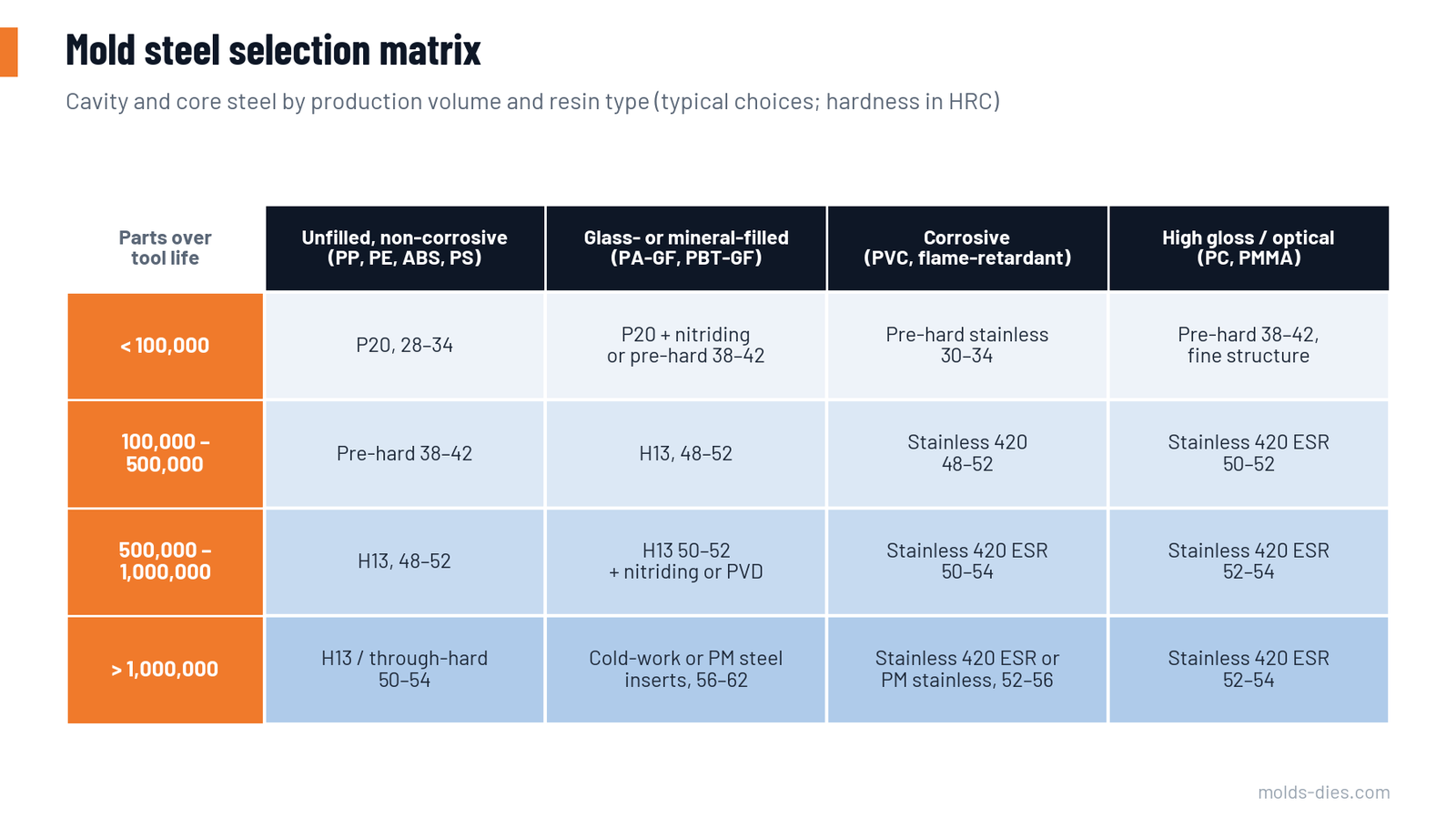
Read the matrix as a starting point. Move one step up in hardness when the part has thin steel conditions that wear quickly (gates, shut-offs, sliding faces), and one step toward a tougher steel when the mold has slender cores or deep ribs that could crack.
By production volume
A widely used classification relates mold construction to expected life:
| Mold class | Expected cycles | Cavity and core steel |
|---|---|---|
| Prototype | Up to about 500 | Aluminum, soft steel, or printed inserts |
| Low volume | Under 100,000 | Pre-hardened steel 28–34 HRC or aluminum |
| Medium volume | Under 500,000 | Pre-hardened steel, 28 HRC minimum; hardened inserts at wear points |
| High volume | Up to 1,000,000 | Hardened steel, 48 HRC minimum, for cavities, cores and wear parts |
| Very high volume | Over 1,000,000 | Hardened steel 48 HRC minimum throughout, hardened slides and wear plates, corrosion-protected cooling |
By resin
| Resin group | Risk | Steel response |
|---|---|---|
| Unfilled PP, PE, PS, ABS | Low wear, no corrosion | Pre-hardened steel is enough for most volumes |
| Glass-fibre or mineral filled (PA-GF, PBT-GF, PP-GF) | Abrasive wear at gates, corners and thin ribs | Hardened steel from medium volume up; nitriding or coating; high-wear gate inserts |
| PVC | Hydrochloric acid released at processing temperature | Stainless steel; avoid dead spots in the flow path |
| Flame-retardant grades, some POM | Corrosive gases | Stainless steel or corrosion-resistant coating; good venting |
| PC, PMMA for transparent or high-gloss parts | Any inclusion or soft spot shows on the part | Remelted stainless or remelted hot-work steel at 50–54 HRC |
| High-temperature resins (PEEK, PPS, PEI) | Mold temperatures of 140–200 °C; often filled | Hot-work steel that keeps its hardness at temperature; hardened stainless for PPS |
By surface finish
| Requirement | What the steel must offer |
|---|---|
| Mirror or optical polish | Remelted (ESR) steel with very low inclusion content, hardness of 50 HRC or more. Stainless 420 ESR is the usual choice |
| High gloss | Clean pre-hardened steel at 38–42 HRC or hardened steel |
| Texture by etching | Uniform structure and hardness over the whole surface; no weld repairs in the textured area; order all cavity blocks from the same heat |
| Technical surfaces | Any grade that meets the wear requirement |
Sulphur is added to some pre-hardened grades to make them easier to machine. Those versions do not polish or etch well. Use them for mold bases and plates, not for cavities with appearance requirements.
Other components
| Component | Usual choice |
|---|---|
| Mold base plates | Plain carbon steel or pre-hardened steel; pre-hardened stainless when corrosion is a concern |
| Slides, lifters, wear plates | Hardened steel, with at least 5 HRC difference between two parts that slide on each other, or one of them nitrided or coated |
| Thin cores, core pins | Hot-work steel at 48–52 HRC for toughness; nitrided standard pins |
| Gate inserts for filled resins | Cold-work or powder-metallurgy steel at 58–62 HRC, or carbide |
| Cores that cannot be water-cooled | High-conductivity copper-alloy inserts with a wear-resistant coating |
Heat treatment and coating notes
- Rough machine, stress relieve, then harden through-hardening steels. Leave enough stock for the distortion: as a guide 0.3–0.5 mm per side on medium-size blocks, more on long or thin parts.
- Temper at least twice, and specify the hardness range on the drawing.
- Nitriding adds a hard surface to P20 and H13 types without significant distortion and is useful against wear at gates and on sliding faces. It reduces weldability.
- PVD coatings reduce wear, sticking and corrosion on cores and cavities, but need a substrate hard enough to support them and a process temperature below the tempering temperature of the steel.
- Welding for engineering changes is easy on pre-hardened steel and demanding on hardened or stainless steel. If frequent changes are expected, consider this in the choice.
Common mistakes
| Mistake | Result |
|---|---|
| P20 cavity for a glass-filled resin at high volume | Gate and parting-line wear, flash, early refurbishment |
| Hardened steel for a 20,000-part project | Extra cost and lead time with no return |
| Non-stainless steel for PVC | Pitted cavity surface within months |
| Sulphur-bearing steel in a polished or textured cavity | Streaks and pits that cannot be removed |
| Same steel and hardness on both sliding partners | Galling and seizure of slides |
| Cavity blocks from different heats in a textured multi-cavity mold | Visible gloss difference between cavities |
Key takeaways
- Decide the steel from volume, resin abrasiveness, corrosion risk and surface finish, in that order.
- Pre-hardened steel at 28–34 HRC covers low and medium volumes of unfilled resins; hardened H13 or stainless 420 at 48–54 HRC covers high volumes, filled resins, corrosive resins and polished surfaces.
- Use special steels locally: high-wear inserts at gates, tough steel in slender cores, copper alloys where cooling is difficult.
- The saving from a cheaper steel is small compared with the cost of one unplanned refurbishment.
Related Articles
Hot Runner vs. Cold Runner: When Each One Pays Off
A cost and technical comparison of hot runner and cold runner injection molds, with a simple break-even calculation to support the decision.
Injection Molding Defects: A Troubleshooting Guide
Short shots, flash, sink marks, warpage, weld lines, burn marks, splay and jetting: causes and a structured order of corrective actions.
Gate Types and Gate Location: How to Choose
A practical guide to choosing the gate type and gate position in injection molds: edge, fan, tunnel, pin-point, diaphragm and valve gates compared.
Injection Mold Cooling Design: Channel Layout and Cycle Time
Sizing and placing cooling channels in injection molds: diameter, pitch and depth rules, turbulent flow, circuit layout and their effect on cycle time.
Exploring the Plastic Injection Molding Process & Types
Learn about the plastic injection molding process, its types, and how it produces high-quality plastic parts for industries like automotive and electronics