
Surface Treatments for Tooling: Nitriding, PVD and When Each Fits
-
 Mohamed Aboelfotouh
- Sector : General
- Oct. 2, 2026, 6:42 p.m.
Tool steel alone cannot always resist the wear, sticking and corrosion that molds and dies meet in service. A surface treatment adds a thin layer that is harder, slides better, or resists chemical attack. The common treatments differ greatly in hardness, thickness and, above all, process temperature, which decides whether the tool keeps its size and core hardness. This article compares them and shows where each one fits.
Two kinds of treatment
Diffusion treatments change the steel surface itself. Nitrogen (nitriding) or nitrogen and carbon (nitrocarburizing) diffuse into the surface and form a hard case that is part of the tool and cannot peel off.
Coatings add a separate layer on top of the steel: hard ceramic compounds by PVD or CVD, carbide layers by thermal diffusion (TD), chromium or nickel by plating.
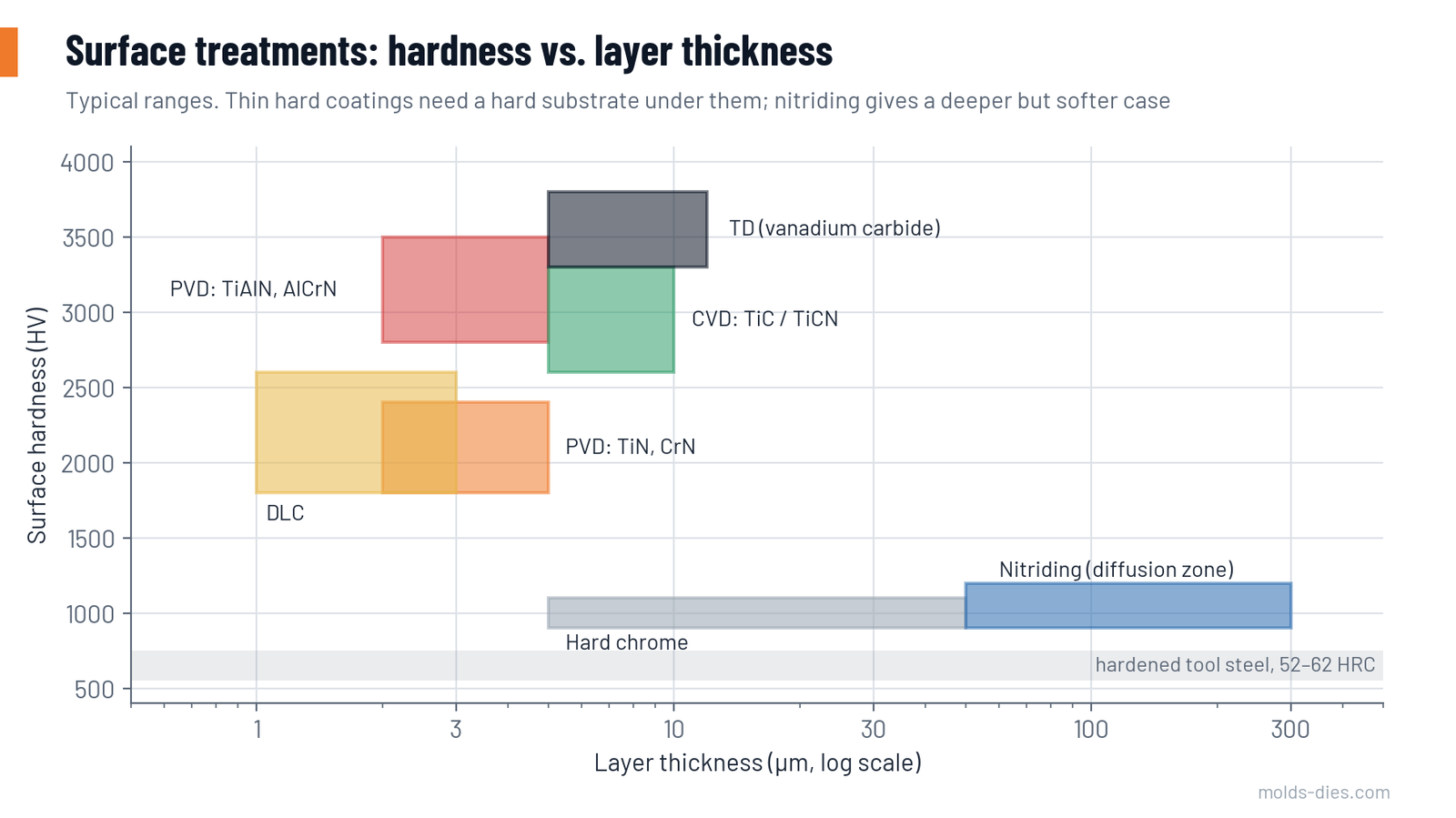
Comparison
| Treatment | Hardness (HV) | Layer thickness | Process temperature | Dimensional change | Re-hardening needed |
|---|---|---|---|---|---|
| Gas or plasma nitriding | 900–1,200 on hot-work steel | 0.05–0.3 mm case | 480–570 °C | Small growth, a few µm | No |
| Nitrocarburizing | 800–1,100 | 10–20 µm compound layer over a diffusion zone | 560–580 °C | Small | No |
| PVD: TiN, CrN | 1,800–2,400 | 2–5 µm | 200–500 °C | Layer thickness only | No |
| PVD: TiCN, TiAlN, AlCrN | 2,800–3,500 | 2–5 µm | 400–500 °C | Layer thickness only | No |
| DLC (carbon) | 1,800–2,600 and above | 1–3 µm | Below about 250 °C | Layer thickness only | No |
| CVD: TiC, TiCN | 2,600–3,300 | 5–10 µm | 900–1,050 °C | Distortion from re-hardening | Yes |
| TD (vanadium carbide) | 3,300–3,800 | 5–12 µm | 900–1,050 °C | Distortion from re-hardening | Hardened during or after the process |
| Hard chrome plating | 900–1,100 | 5–50 µm | About 50–60 °C | Layer thickness; builds up on edges | No |
| Electroless nickel | 500–1,000 after heat treatment | 5–50 µm, very uniform | About 90 °C | Layer thickness | No |
For reference, hardened tool steel at 52–62 HRC is about 550–750 HV.
Nitriding
Nitriding gives a hard case that supports load, resists wear and reduces the tendency of aluminum to stick. Because the case is tenths of a millimetre deep, it tolerates light polishing and local pressure better than a thin coating.
| Point | Guidance |
|---|---|
| Suitable steels | Hot-work steels (H13, H11), pre-hardened mold steels, stainless mold steels (with reduced corrosion resistance afterwards) |
| Condition before treatment | Hardened and tempered at least 30 °C above the nitriding temperature, finish machined |
| Compound ("white") layer | Hard and brittle. Useful for sliding wear; avoided or kept very thin on die-casting dies and sharp edges, where it chips and starts cracks |
| Case depth | Shallow (0.05–0.1 mm) for die-casting dies; about 0.1–0.2 mm for extrusion die bearings; up to 0.3 mm for molds and forging dies |
| Repeat treatment | Extrusion dies are re-nitrided regularly; too many cycles build an over-thick, brittle case, so the old layer must be controlled |
| Process choice | Plasma nitriding gives the best control of the compound layer and allows masking; gas nitriding suits batches and deep holes |
PVD coatings
PVD deposits a very hard, thin, smooth layer at temperatures low enough for many tool steels. It is a line-of-sight process: deep holes and narrow slots are coated poorly.
| Coating | Character | Typical tooling use |
|---|---|---|
| TiN | General purpose, gold colour, makes wear visible | Mold cores, punches, general wear protection |
| TiCN | Harder, lower friction; less heat resistance | Punching and forming of steel sheet |
| TiAlN / AlTiN | Keeps its hardness at high temperature | Cutting tools; die-casting core pins |
| AlCrN | High hardness with very good oxidation resistance | Punching and forming of high-strength sheet; die-casting inserts and cores |
| CrN | Tougher and less hard; resists sticking and corrosion; can be applied at lower temperature | Plastic molds for sticky or corrosive resins; aluminum contact; copper forming |
| DLC | Very low friction, also when running dry | Ejector pins and slides without grease; forming aluminum |
High-temperature coatings: CVD and TD
Both processes work at about 1,000 °C and bond extremely well. They are the strongest answer to galling in drawing and forming dies for stainless and high-strength steel. The price is that the tool is hardened again after coating, with the distortion that brings. Use them on tools whose final size can be adjusted afterwards or whose tolerances are wide, such as draw rings and form rolls, and on steels that harden with little size change.
Plating
Hard chrome gives moderate hardness, low friction and corrosion resistance at a low process temperature. It suits molds for corrosive resins and release-critical surfaces. It builds up thickly on outside edges and thinly in recesses, can crack or peel under high local pressure, and is subject to increasing environmental restrictions.
Electroless nickel deposits with uniform thickness everywhere, including inside holes. It is mainly a corrosion barrier, for example for mold plates and cooling circuits, and is softer than the other layers.
Which treatment for which tool
| Tool and problem | First choice | Alternative |
|---|---|---|
| Aluminum extrusion die: bearing wear and pick-up | Nitriding, repeated at set intervals | Additional hard coating on the bearing for long runs |
| Die-casting core pins and inserts: soldering, erosion | Nitriding followed by PVD (AlCrN or CrN type) | Nitriding only |
| Die-casting cavity: heat checking | Shallow nitriding without compound layer | No coating; control temperature instead |
| Injection mold cavity for glass-filled resin: abrasion | PVD (TiN or CrN type) on hardened steel | Nitriding of gate areas |
| Injection mold for PVC or flame-retardant resin: corrosion | Stainless steel; CrN coating | Hard chrome or nickel on non-stainless steel |
| Mold parts that stick or need dry running: ejectors, slides, unscrewing cores | DLC or CrN | Nitriding |
| Cutting punches for steel sheet: abrasive and adhesive wear | PVD (TiCN or AlCrN type) on high-temperature-tempered or PM steel | — |
| Drawing and forming dies for stainless steel: galling | TD or CVD carbide coating | PVD AlCrN on a polished tool |
| Forming aluminum sheet: pick-up | DLC | Polished CrN |
| Cooling channels, mold plates: rust | Electroless nickel | Stainless steel |
Conditions for success
- The substrate must be hard enough. A 3 µm coating on soft steel is pressed in and cracks like an eggshell. For PVD on cutting and forming tools the substrate should be at about 58 HRC or more; on molds, at least 48–50 HRC or a nitrided surface.
- Tempering temperature above process temperature. If the steel was tempered at 200 °C and is coated at 450 °C, it softens and changes size. Choose the steel and the tempering regime with the coating in mind: high-temperature tempered D2-type steels, hot-work steels, high-speed and PM steels are suitable.
- Surface finish before coating. The coating copies the surface; it does not smooth it. Polish working surfaces and remove grinding burn and the EDM recast layer, on which coatings do not adhere.
- Clean, sharp-edge management. A light edge hone on cutting tools prevents the coating from chipping at the edge.
- Tolerances. Allow for the layer thickness on fits: 2–5 µm per surface for PVD, more for plating. Mask or specify the surfaces that must not be treated.
- Combine where it helps. Nitriding first and PVD on top (a duplex treatment) gives the thin hard coating a hard, deep support. It is the standard solution for die-casting cores.
- Plan the recoat. Most PVD coatings can be stripped and reapplied after regrinding or repolishing. Keep a record of how many times each tool has been treated.
Common mistakes
| Mistake | Result |
|---|---|
| Coating a tool tempered at low temperature | Core softens; size changes |
| PVD on a pre-hardened steel at 30 HRC under high contact pressure | Coating collapses into the substrate |
| Thick compound layer on a die-casting cavity | Layer cracks; heat checks start early |
| Coating over an EDM surface | Flaking |
| Hard chrome on sharp cutting or shut-off edges | Build-up and chipping at the edge |
| CVD or TD on a tight-tolerance cutting die | Distortion after re-hardening |
| Expecting a coating to cure a design or alignment fault | Short-lived improvement |
Key takeaways
- Nitriding gives a deep, supportive case at 900–1,200 HV; PVD gives a very hard 2–5 µm layer at 1,800–3,500 HV; CVD and TD give the best galling resistance but need re-hardening.
- Process temperature decides compatibility: the steel must have been tempered above it.
- A hard, clean, well-finished substrate is the condition for any coating to last.
- Match the treatment to the failure: nitriding for extrusion and die casting, PVD for punches and mold wear, TD or CVD for galling in forming, CrN or plating for corrosion and release.
Related Articles
Preventive Maintenance Program for Molds and Dies
How to set up preventive maintenance for molds and dies: service levels, intervals by shot count, checklists, spare parts and tool history records.
How to Estimate the Cost of a Mold or Die
A structured method for estimating tooling cost: material, standard parts, design and machining hours, heat treatment, trials, overhead and margin.
Laser Hardening in Manufacturing
Laser hardening is a precise surface heat treatment that improves wear resistance and durability of steel components with minimal distortion compared to traditional hardening methods.
Heat Treatment: Concept and Methods
Understand the various heat treatment methods like annealing, quenching, and tempering, used to alter the properties of steel and other materials
Understanding Molds and Dies: Differences, Types, and Applications
Explore the differences between molds and dies, their types, and applications in modern manufacturing. Learn how these tools shape raw materials into finished products
Punch and Die Steels: Grade, Hardness and Coating by Application
How to choose tool steel, hardness and coating for punches and dies from the failure mode: wear, chipping, galling or cracking.