
Die Life in HPDC: Heat Checking, Soldering and How to Delay Them
-
 Mohamed Aboelfotouh
- Sector : Die Casting
- Oct. 2, 2026, 4:06 p.m.
A die casting die for aluminum is a large investment, and its life is counted in shots. Some dies need major repair after 50,000 shots while others making similar parts pass 200,000. The difference is rarely luck. It comes from steel quality, heat treatment, die design and the way the die is run. This article describes the four failure modes and what delays each of them.
The four failure modes
| Failure mode | What you see | Root cause | Share of die failures |
|---|---|---|---|
| Heat checking (thermal fatigue) | Fine network of cracks on the cavity surface, reproduced as raised lines on the casting | Repeated heating and cooling of the surface | The most common by far |
| Soldering | Aluminum stuck to the steel; drag marks and torn casting surface | Chemical reaction between molten aluminum and iron | Common near gates and on cores |
| Erosion (washout) | Steel worn away in front of the gate or on cores | High-velocity metal, especially with solid particles | Local, near gates |
| Gross cracking | A single deep crack, often from a corner or a cooling hole | Thermal shock or overload on a brittle or stressed die | Rare but ends the die |
Heat checking
At every shot the cavity surface is heated by the metal in a fraction of a second and then cooled by the die spray. The surface layer tries to expand and contract, but the cooler steel below holds it back. The result is alternating compressive and tensile stress, and after thousands of cycles small cracks start and grow.
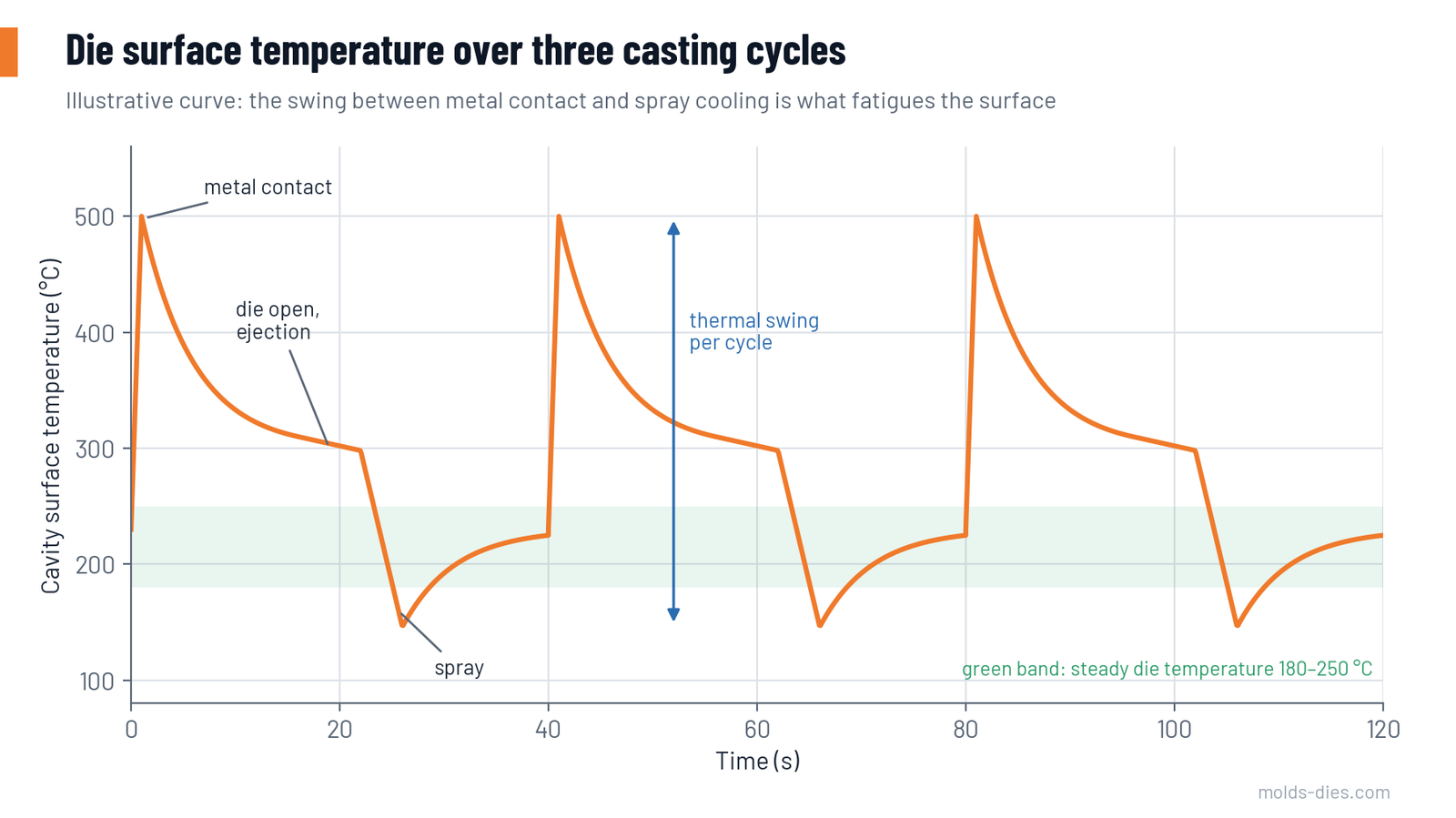
Two things drive it: the size of the temperature swing, and the strength of the steel at the peak temperature. Everything that reduces the swing or keeps the steel strong when hot delays heat checking.
| Measure | Why it helps |
|---|---|
| Preheat the die to 180–250 °C before the first shot | The steel is much tougher warm than cold, and the first swings are smaller |
| Keep the die temperature stable with internal cooling and heating circuits | A steady base temperature means a smaller swing |
| Use the minimum amount of spray, finely atomized | Spray is the cold half of the cycle; flooding the surface doubles the thermal shock |
| Lower the melt temperature to what the casting needs | Every 10–20 °C of unnecessary superheat raises the peak |
| Avoid long stops with the die open and cooling water running | Restarting on a cold die repeats the start-up shock |
| Higher hardness within the allowed range | Resists crack initiation, but only if toughness is still adequate |
Soldering
Molten aluminum dissolves iron. Where the protective lubricant film is washed away and the steel is hot, an iron–aluminum layer forms and the casting welds itself to the die.
Measures:
- Lower the local temperature: spot cooling in cores and near the gate.
- Reduce gate velocity and avoid direct impingement: keep aluminum below about 60 m/s and do not aim the gate at a core or a wall.
- Check the alloy's iron content: aluminum die casting alloys with roughly 0.8–1.1 % iron solder much less than low-iron alloys. Low-iron structural alloys rely on manganese and need more care.
- Use a surface treatment: nitriding, or a PVD coating on cores and inserts, puts a barrier between aluminum and steel.
- Apply draft and polish in the direction of ejection: rough or undercut surfaces start soldering earlier.
Erosion
Erosion is mechanical wear by the metal stream. It appears where the stream hits steel at high speed soon after the gate. It gets worse when the metal already carries solid particles, which happens when the melt or the shot sleeve is too cold.
Measures: lower gate velocity, a gate direction that lets the metal run along the surface instead of against it, replaceable inserts at the impact point, and a coating on those inserts.
Gross cracking
A deep crack means the steel was loaded beyond its toughness. Typical triggers:
- a cold start: steel at room temperature has only a fraction of its warm toughness;
- sharp internal corners in the cavity or at the bottom of cooling holes;
- cooling channels too close to the cavity surface;
- hardness too high for the size of the die, or a slow quench that left a brittle structure;
- the recast "white layer" left by EDM, which is hard, brittle and already full of micro-cracks.
Steel and heat treatment
| Item | Recommendation |
|---|---|
| Steel type | Hot-work tool steel of the H13 or H11 family, or a modified grade with higher toughness, in premium quality (electroslag remelted, checked for cleanliness and structure) |
| Hardness for aluminum dies | 44–48 HRC. Large dies and dies with deep ribs at the lower end; small inserts and cores at the upper end |
| Quench | As fast as the die shape allows without distortion or cracking; a slow quench lowers toughness even at the correct hardness |
| Tempering | At least two tempers, three for large dies, at the same temperature level |
| After EDM | Remove the white layer by polishing or fine finishing passes, then stress temper about 25–30 °C below the last tempering temperature |
| Surface | Nitriding in a shallow, controlled depth; avoid a thick brittle compound layer in the cavity |
Design rules that add die life
| Feature | Rule |
|---|---|
| Internal corners in the cavity | Largest radius the part allows; avoid anything below about 1 mm |
| Cooling channels | Distance from channel to cavity surface at least 1.5–2 times the channel diameter; no sharp bottoms in drilled holes |
| Inserts | Put areas that wear or check early (gate area, cores, thin steel sections) in replaceable inserts |
| Thin steel conditions | Avoid tall, thin steel walls between ribs; they overheat and crack |
| Die size | Enough steel around the cavity for stiffness: flash from a flexing die wears the parting face |
Operating rules
- Preheat with hot oil, electric heaters or a gas burner to 180–250 °C. Do not preheat by making castings on a cold die.
- Start slowly: a few shots at reduced speed and pressure before full production.
- Record the die temperature at fixed points every shift with a contact or infrared thermometer.
- Keep the spray pattern fixed: same nozzles, same time, same dilution. Any hand spray added by the operator should be the exception.
- Stress temper the die after the first 5,000–10,000 shots and then at regular intervals, for example every 25,000–50,000 shots. This removes the residual stress that has built up in the surface.
- Polish out early heat checks at each service before they deepen, and weld-repair only with matching filler, preheat and a temper afterwards.
- Keep a shot counter and a history card for each die: shots, repairs, stress tempers, inserts changed.
What life to expect
| Die for | Typical life to major repair (shots) |
|---|---|
| Aluminum, cosmetic surface parts | 80,000–150,000 |
| Aluminum, structural or functional parts | 100,000–200,000 and more |
| Magnesium | 200,000–500,000 |
| Zinc | 500,000 to over 1,000,000 |
These are ranges, not guarantees. The same die can sit at either end depending on preheating, spray and stress relief alone.
Key takeaways
- Heat checking is thermal fatigue. Reduce the temperature swing (preheat, stable die temperature, minimal spray) and keep the steel tough.
- Soldering and erosion are local problems near gates and cores: lower velocity, redirect the flow, cool the spot and coat it.
- Specify premium H13-type steel at 44–48 HRC with a fast quench and multiple tempers, and remove the EDM white layer.
- Preheating, a fixed spray routine and periodic stress tempering cost little and add tens of thousands of shots.
Related Articles
Choosing a Die Casting Machine: Locking Force and Shot Size
How to calculate locking force, shot weight, plunger diameter and sleeve fill ratio to match a casting to the right cold-chamber die casting machine.
Overflows, Vents and Vacuum: Getting the Air Out of the Die
Practical rules for placing and sizing overflows, vents, chill vents and vacuum channels in high-pressure die casting dies.
Porosity in Die Casting: Gas vs. Shrinkage, Causes and Fixes
How to tell gas porosity from shrinkage porosity in die castings, what causes each one, and the process and die changes that actually reduce them.
HPDC Gating Design: Gate Area, Gate Velocity and Fill Time
A step-by-step method to size the gate of a high-pressure die casting die from cavity fill time and gate velocity, with a worked example and reference tables.
High-Pressure Die-Casting Process
Explore the high-pressure die-casting process, a method for producing metal parts with high precision and uniformity. Learn its benefits and applications
Preventive Maintenance Program for Molds and Dies
How to set up preventive maintenance for molds and dies: service levels, intervals by shot count, checklists, spare parts and tool history records.