LogBook

Molds & Dies

  • Design
    Punching Die Cutting Force Calculator
    Plastic Injection Molding Clamping Force Calculator Plastic's Shrinkage Table
    Aluminum Extrusion Die Bearing Length Calculator Aluminum Extrusion Troubleshooting
    High-Pressure Die Casting Clamping Force Calculator High-Pressure Die Casting Draft Angle Calculator
    High-Pressure Die Casting Troubleshooting
  • Machining
    Milling Cutting Conditions Calculator
    EDM Wirecut Cutting Speed/Time Calculator
    Material's Hardness Converter Table
    Machining Troubleshooting
  • RFM
  • About
  • Contact
Search
Sectors
  • Aluminum Extrusion (7)
  • Die Casting (6)
  • General (6)
  • Machining (7)
  • Plastic Injection (6)
  • Sheet Metal (9)
Latest Article
  • Preventive Maintenance Program for Molds and Dies
    Oct. 2, 2026, 6:42 p.m.
  • How to Estimate the Cost of a Mold or Die
    Oct. 2, 2026, 6:42 p.m.
  • Surface Treatments for Tooling: Nitriding, PVD and When Each Fits
    Oct. 2, 2026, 6:42 p.m.
  • Trochoidal Milling and Chip Thinning in Tool Steel
    Oct. 2, 2026, 6:41 p.m.
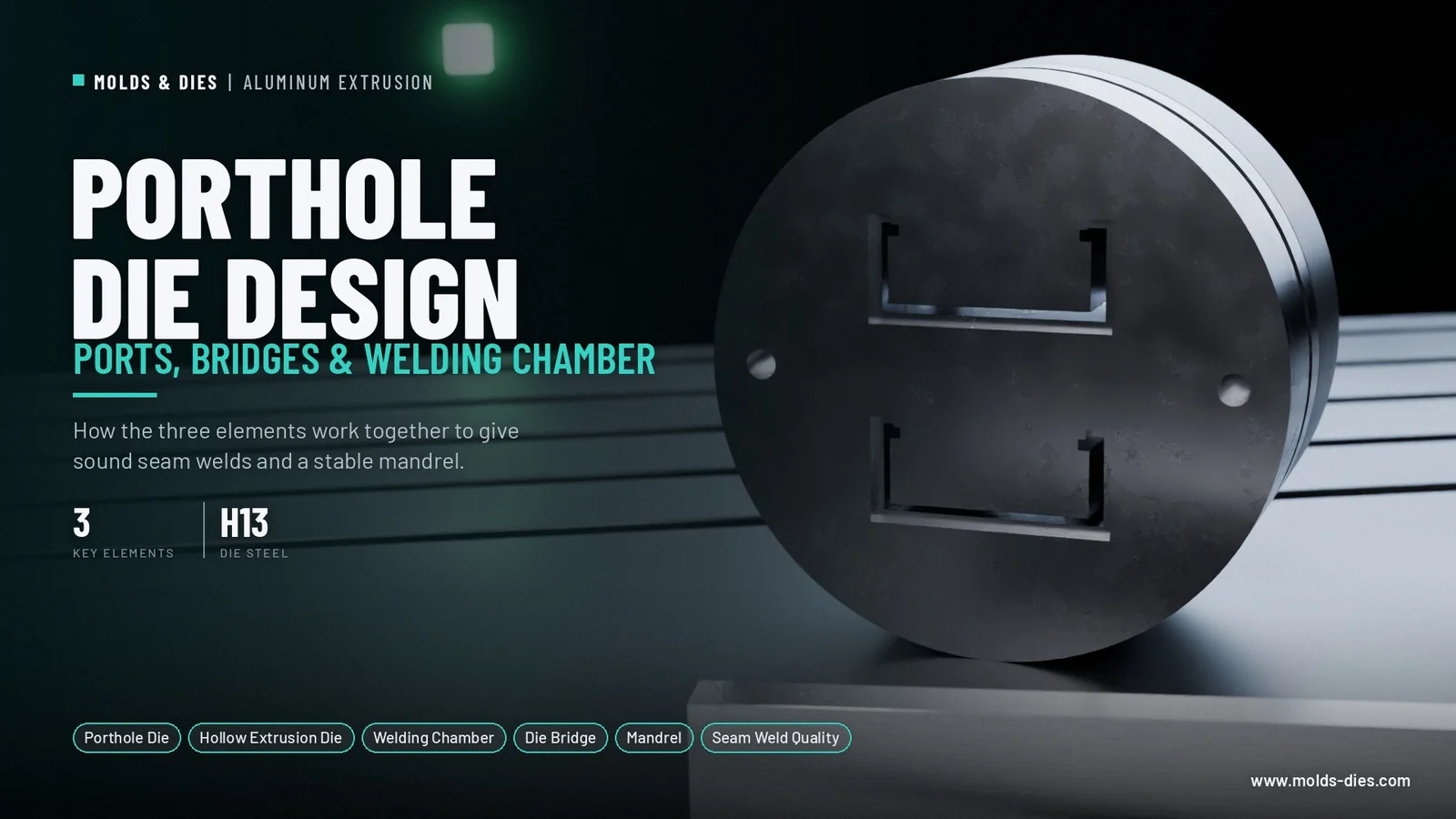
Porthole Die Design: Ports, Bridges and Welding Chamber

Porthole Die Design: Ports, Bridges and Welding Chamber

  • Mohamed Aboelfotouh Mohamed Aboelfotouh
  • Sector : Aluminum Extrusion
  • Oct. 2, 2026, 4:09 p.m.

Hollow aluminum profiles such as tubes, window frames and heat-sink housings are extruded through porthole dies. The billet is split into several streams, the streams pass around a mandrel that forms the inside of the profile, and they weld together again ....

Continue Reading
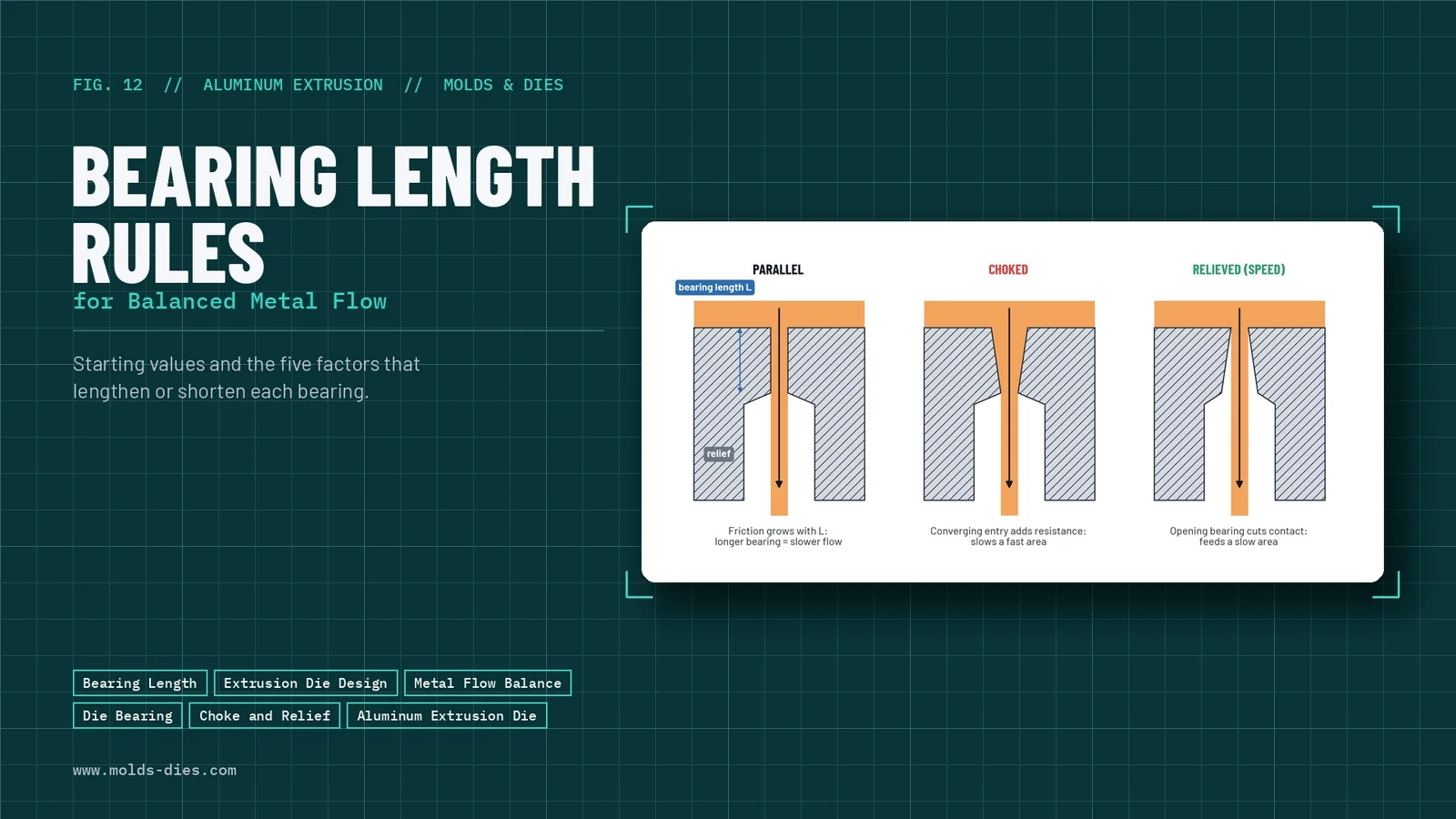
Bearing Length Rules for Balanced Metal Flow

Bearing Length Rules for Balanced Metal Flow

  • Mohamed Aboelfotouh Mohamed Aboelfotouh
  • Sector : Aluminum Extrusion
  • Oct. 2, 2026, 4:08 p.m.

In an extrusion die, every part of the profile opening must release metal at the same speed. If one wall runs faster than its neighbour, the profile bends, twists, waves or tears. The bearing, the short land that gives the profile its final shape, is the ....

Continue Reading
Extrusion Defects: Die Lines, Pick-Up, Tearing and Their Fixes

Extrusion Defects: Die Lines, Pick-Up, Tearing and Their Fixes

  • Mohamed Aboelfotouh Mohamed Aboelfotouh
  • Sector : Aluminum Extrusion
  • Oct. 2, 2026, 4:08 p.m.

Most defects on aluminum extrusions come from one of three places: the die, the billet, or the press settings. A fourth group arises after the die, during quenching, pulling, stretching and ageing. Knowing which area to look at first saves trials and scra ....

Continue Reading
Mold Steel Selection by Production Volume and Resin

Mold Steel Selection by Production Volume and Resin

  • Mohamed Aboelfotouh Mohamed Aboelfotouh
  • Sector : Plastic Injection
  • Oct. 2, 2026, 4:08 p.m.

Steel is a small part of the price of an injection mold, usually 5–15 %, but it decides how long the mold lasts, how well it polishes, and how much it costs to maintain. Choosing a steel that is too soft leads to worn gates and flashing parting lines half ....

Continue Reading
Hot Runner vs. Cold Runner: When Each One Pays Off

Hot Runner vs. Cold Runner: When Each One Pays Off

  • Mohamed Aboelfotouh Mohamed Aboelfotouh
  • Sector : Plastic Injection
  • Oct. 2, 2026, 4:07 p.m.

A hot runner keeps the plastic molten all the way to the gate, so no runner is molded and thrown away with each shot. A cold runner is molded and ejected with the parts. The hot runner costs more to buy and to maintain; the cold runner costs more per part ....

Continue Reading
Injection Molding Defects: A Troubleshooting Guide

Injection Molding Defects: A Troubleshooting Guide

  • Mohamed Aboelfotouh Mohamed Aboelfotouh
  • Sector : Plastic Injection
  • Oct. 2, 2026, 4:07 p.m.

When a molded part shows a defect, the usual reaction at the machine is to raise the pressure or the temperature until it goes away. That often replaces one defect with another and leaves a process that runs at the edge of its window. A better approach is ....

Continue Reading
Gate Types and Gate Location: How to Choose

Gate Types and Gate Location: How to Choose

  • Mohamed Aboelfotouh Mohamed Aboelfotouh
  • Sector : Plastic Injection
  • Oct. 2, 2026, 4:06 p.m.

The gate is where the runner meets the part. Its type decides how the part is separated from the runner and what mark is left. Its position decides how the cavity fills: where the weld lines form, where air is trapped, and how the part shrinks and warps. ....

Continue Reading
Injection Mold Cooling Design: Channel Layout and Cycle Time

Injection Mold Cooling Design: Channel Layout and Cycle Time

  • Mohamed Aboelfotouh Mohamed Aboelfotouh
  • Sector : Plastic Injection
  • Oct. 2, 2026, 4:06 p.m.

In most injection molds, cooling takes more than half of the cycle. It also decides whether the part comes out flat or warped. Yet cooling channels are often drilled last, wherever the ejector pins and screws leave room. This article gives the rules for s ....

Continue Reading
Die Life in HPDC: Heat Checking, Soldering and How to Delay Them

Die Life in HPDC: Heat Checking, Soldering and How to Delay Them

  • Mohamed Aboelfotouh Mohamed Aboelfotouh
  • Sector : Die Casting
  • Oct. 2, 2026, 4:06 p.m.

A die casting die for aluminum is a large investment, and its life is counted in shots. Some dies need major repair after 50,000 shots while others making similar parts pass 200,000. The difference is rarely luck. It comes from steel quality, heat treatme ....

Continue Reading
Choosing a Die Casting Machine: Locking Force and Shot Size

Choosing a Die Casting Machine: Locking Force and Shot Size

  • Mohamed Aboelfotouh Mohamed Aboelfotouh
  • Sector : Die Casting
  • Oct. 2, 2026, 4:05 p.m.

A casting put on a machine that is too small flashes, wears the die and gives porous parts. A machine that is too large costs more per hour and often fills the shot sleeve so poorly that air is mixed into every shot. Matching the casting to the machine ta ....

Continue Reading
Overflows, Vents and Vacuum: Getting the Air Out of the Die

Overflows, Vents and Vacuum: Getting the Air Out of the Die

  • Mohamed Aboelfotouh Mohamed Aboelfotouh
  • Sector : Die Casting
  • Oct. 2, 2026, 4:05 p.m.

Before every shot, the cavity, the runner and the empty part of the shot sleeve are full of air. The metal fills the cavity in a few hundredths of a second, so that air has very little time to leave. What does not leave ends up inside the casting as gas p ....

Continue Reading
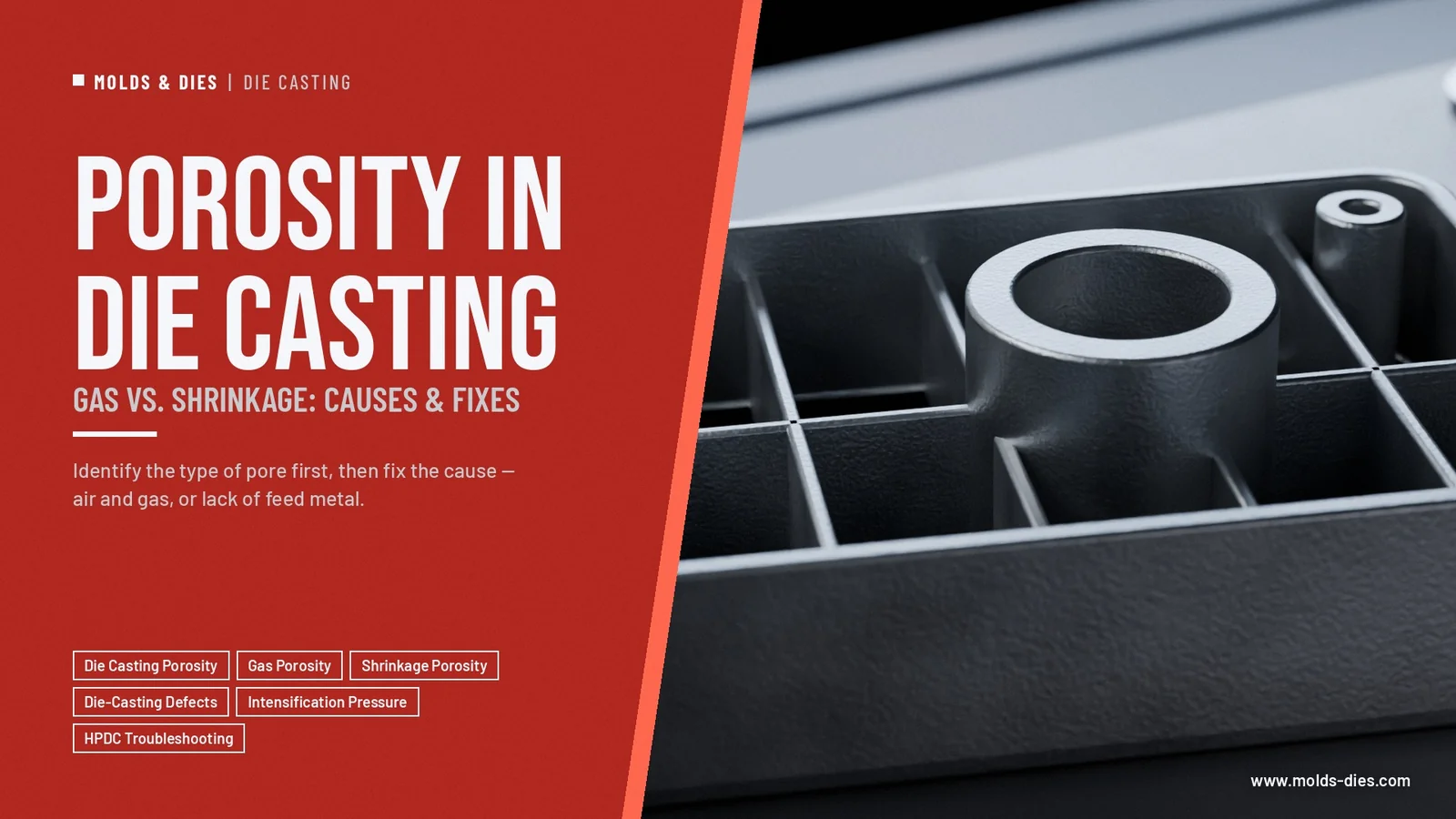
Porosity in Die Casting: Gas vs. Shrinkage, Causes and Fixes

Porosity in Die Casting: Gas vs. Shrinkage, Causes and Fixes

  • Mohamed Aboelfotouh Mohamed Aboelfotouh
  • Sector : Die Casting
  • Oct. 2, 2026, 4:04 p.m.

Porosity is the most common reason die castings are rejected for leaks, weak sections or holes opened by machining. There are two different kinds, with different causes and opposite fixes. Adding pressure will not remove trapped air, and better venting wi ....

Continue Reading
HPDC Gating Design: Gate Area, Gate Velocity and Fill Time

HPDC Gating Design: Gate Area, Gate Velocity and Fill Time

  • Mohamed Aboelfotouh Mohamed Aboelfotouh
  • Sector : Die Casting
  • Oct. 2, 2026, 4:01 p.m.

The gate is the smallest section in the whole feeding system of a die casting die, and it controls two things at once: how long the cavity takes to fill and how fast the metal enters it. If the gate is too small, the machine cannot deliver the flow and th ....

Continue Reading
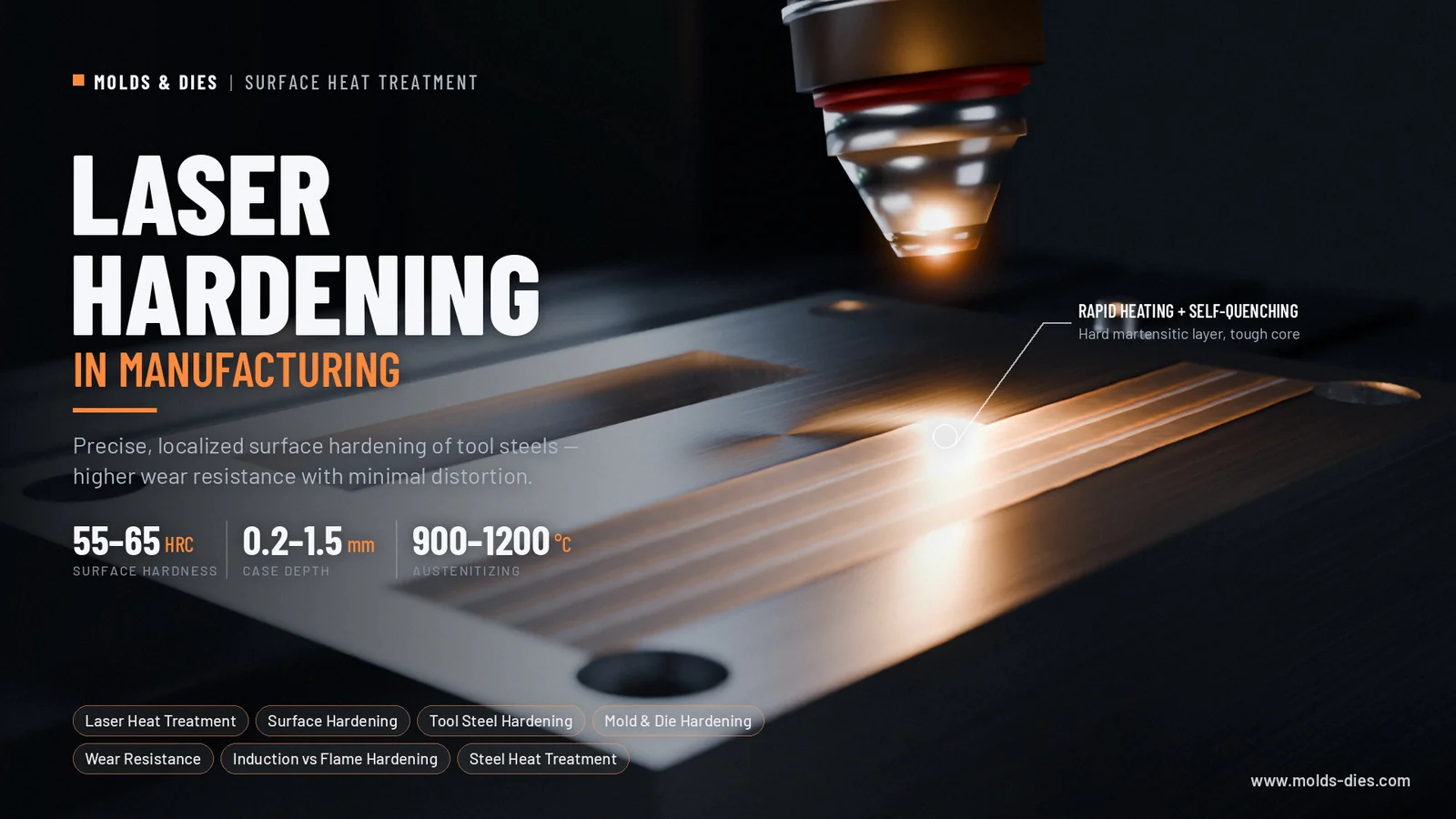
Laser Hardening in Manufacturing

Laser Hardening in Manufacturing

  • Mohamed Aboelfotouh Mohamed Aboelfotouh
  • Sector : General
  • March 12, 2026, 10:19 p.m.

In modern manufacturing, improving the wear resistance and fatigue life of components is essential, especially for tooling, molds, and mechanical parts subjected to repeated loads. Traditional heat treatment methods have been used for decades to harden st ....

Continue Reading
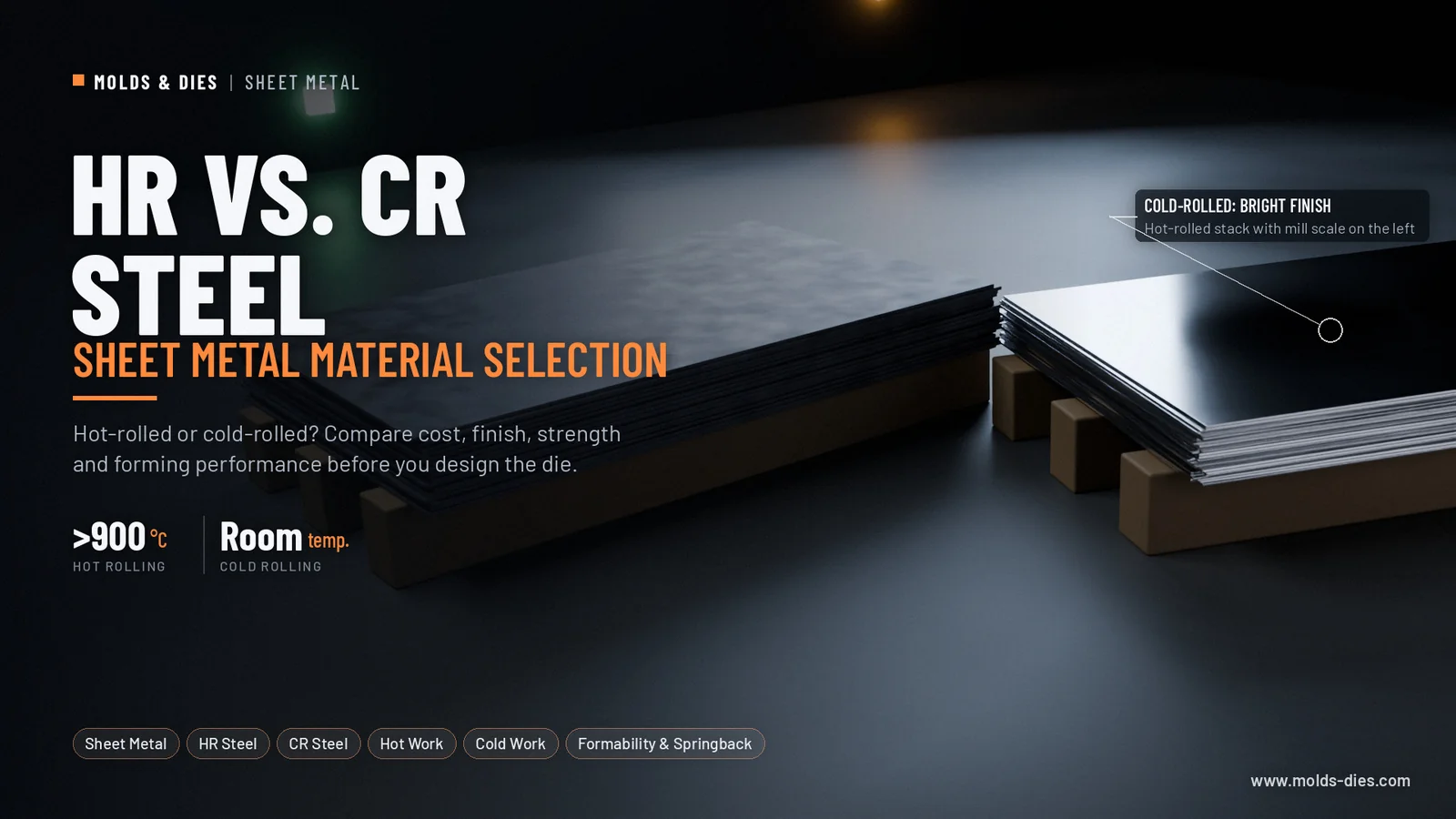
Sheet Metal Material Selection: HR vs. CR Steel

Sheet Metal Material Selection: HR vs. CR Steel

  • Mohamed Aboelfotouh Mohamed Aboelfotouh
  • Sector : Sheet Metal
  • June 12, 2025, 1:36 p.m.

Choosing the right material is one of the first and most critical decisions in sheet metal die design. The material’s mechanical properties, surface finish, and manufacturing history directly impact forming quality, tool wear, and final product performanc ....

Continue Reading
Load more articles

LogBook

Molds & Dies Website offers expert articles on plastic injection molds, sheet metal dies, high-pressure die casting, and aluminum extrusion for enthusiasts and professionals.

Quick Links
  • About
  • Contact
  • Privacy Policy
  • Disclaimer
Subscribe Newsletter

Copyright © 2023-2026 Molds & Dies | All Rights Reserved